GALAXY
A
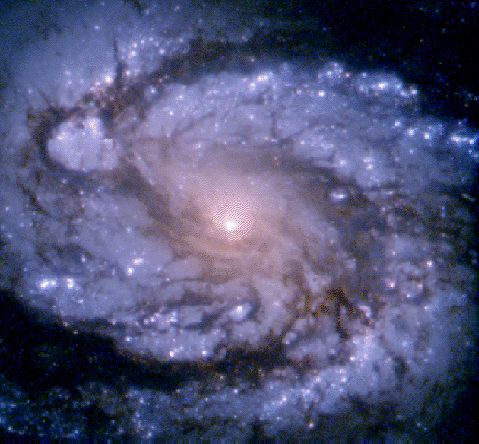
large collection of stars, gas, and dust. It
contains an average of 100 billion stars. It
can be from one thousand five hundred to three hundred thousand light years
across.
1.
A galaxy is cluster of stars, dust, and gas held
together by gravity
2.
Galaxies vary drastically in size, they have
between 10 billion and 1 trillion stars
3.
range from a few thousand to a million light years
in diameter
4.
May be alone or in a large group of galaxies called
a “supercluster.”
5.
Almost all galaxies have a nucleus, which is the
bright central part
6.
belief that there may even be enormous black holes
in the center of some galactic nuclei
7.
galaxies classified by their shapes and divided
into two main groups, elliptical and spiral
8.
Irregular shaped galaxies have undefined shape
-- full of young stars, dust, and gas
9.
Spiral galaxies -- disk-shaped, with spiral arms
that appear quite blue -- contain
more middle-aged stars, clouds of gas and dust
10.
Elliptical galaxies – vary in shape from round to
flattened, elongated spheres – contain older stars, very little gas and dust
– typically appear yellow-red