ASTEROID, ASTEROID BELT
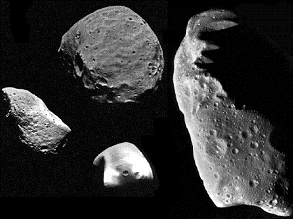
Small celestial bodies (in the sky) that revolve around the sun. Their orbits are chiefly in a belt between Mars and Jupiter. The diameters of these rock like objects are between a few and several hundred kilometers.
1.
Considered to be debris left over after the Sun and
all the planets were formed
2.
Scientists think that most asteroids are the result
of collisions between larger rocky space bodies
3.
Ceres -- the largest asteroid found in the asteroid
belt -- is as big as the state of Texas.
4.
The belt probably contains at least 40,000
asteroids that are more than 0.5 miles across
5.
This "belt" of asteroids follows a
slightly elliptical path as it orbits the Sun in the same direction as the
planets.
6.
It takes anywhere from three to six Earth years for
a complete revolution around the Sun.
7.
If captured by the gravitational pull of a planet,
the asteroid can be pulled out of the belt and go into orbit as a moon
(satellite) around the planet that pulled on it.
8.
Jupiter exerting its gravitational force on the
asteroids in the belt protects the inner planets-Mercury, Venus, Earth and Mars-
from being bombarded by repeated large asteroid collisions
9.
Asteroid capable of colliding with a planet
resulting in the formation of an impact crater- Theory that such an event in
Yucatan Peninsula, Mexico led to extinction of dinosaurs on Earth
10.
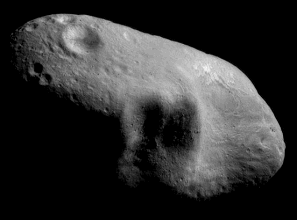
Feb. 12, 2001 -- NEAR-Shoemaker, a robot
spacecraft, became first spacecraft to land on an asteroid and send signals back
from its surface. Orbited
asteroid 433 Eros, 145 million miles from Earth, for a year before landing on
it.