LUNAR ECLIPSE
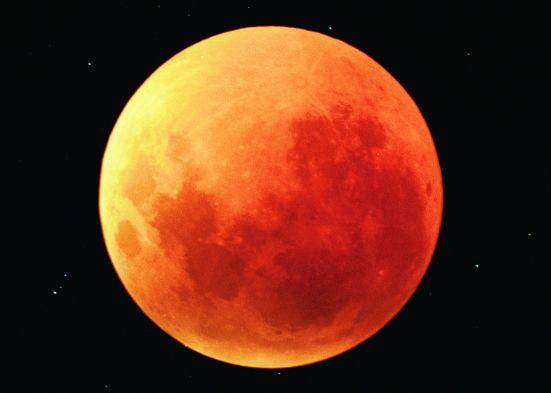
Sometimes, as the Earth orbits the Sun, it comes between the Sun and the Moon. When this happens, the Earth can throw a dark shadow across the moon, and block the Sun’s light from hitting it. This is an eclipse of the moon.

1.
Can only occur at Full Moon, and only if the Moon
passes through some portion of the Earth's shadow.
2.
shadow is actually composed of two cone-shaped
components, one nested inside the other.
3.
Outer or penumbral shadow is zone where Earth
blocks part but not all of the Sun's rays from reaching Moon
4.
Inner or umbral shadow is region where Earth blocks
all direct sunlight from reaching the Moon.
5.
three basic types of lunar eclipses
-- penumbral, partial, and total
6.
Penumbral -- Moon passes through Earth's penumbral
shadow – subtle and quite difficult to observe.
7.
Partial -- portion of Moon passes through Earth's
umbral shadow -- easy to see, even with the unaided eye.
8.
Total -- entire Moon passes through Earth's umbral
shadow – striking for reddish hue as earth bends light from Sun around the
atmosphere (absorbing other colors present in sunlight more than it does red)
and reflects it toward Moon
9.
Unlike solar eclipses, last for a long duration of
time—up to two hours
10.
Unlike solar eclipses, can be seen by anyone on the
night side of the Earth