SOLAR ECLIPSE
Sometimes,
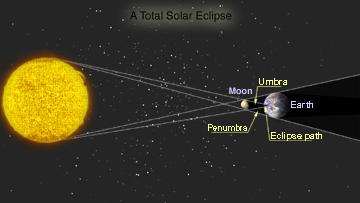
the Moon passes between the Earth and the Sun. An eclipse of the Sun occurs when the Earth passes through the
Moon’s shadow. When this happens,
the Moon blocks the light of the Sun as a shadow of the Moon is cast on the
Earth's surface. This is an
eclipse of the Sun.
1.
Can only occur at New Moon when the Moon passes
between Earth and Sun. If Moon's shadow happens to fall upon Earth’s surface
at that time, we see some portion of the Sun's disk covered or 'eclipsed' by the
Moon.
2.
Moon’s shadow usually moves from west to east at
speed of 2,000 miles per hour.
3.
Moon’s shadow has two parts – penumbra and umbra
4.
Three types – total eclipse, annular eclipse, partial eclipse
5.
When only Moon's penumbral shadow strikes Earth, we
see a partial eclipse of the Sun from that region
6.
When Moon only darkens the middle of the sun,
leaving a bright ring around the edges visible
7.
If Moon's dark umbral shadow sweeps across Earth's
surface, then total eclipse of the Sun is seen
8.
The track of Moon's shadow across Earth's surface
is called Path of Totality -- typically 10,000 miles long but only 100 miles or
so wide. Must be in this path in order to see the Sun totally eclipsed by the
Moon; make total eclipses rare and lasting on average 2.5 minutes.
9.
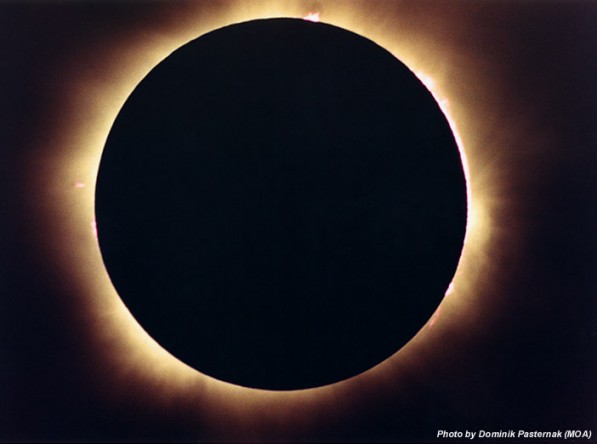
At moment of total eclipse, halo, called the corona,
flashes into view around darkened sun
10.
Solar eclipses are harmful and not to be viewed
directly with naked eye. Sun gives
off invisible infrared rays that can damage eyes.
Only view with pinhole projector or similar device.