JUPITER
The
largest planet. It is mostly a ball
of gas eleven times the diameter of earth.
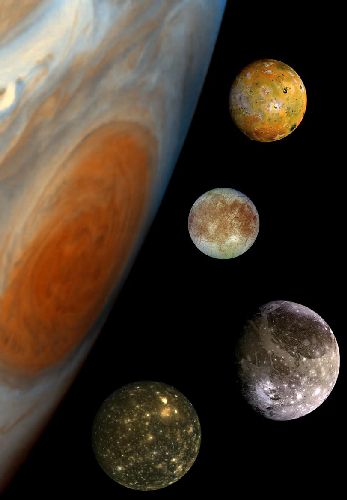
Its red spot is a giant hurricane like storm that has been there for
hundreds of years. You can see the
moons of Jupiter with a telescope.
1.
Fifth planet from the Sun, by far, the largest
planet in the solar system
2.
Mass exceeds that of all other planets combined
3.
A gas planet comprised mostly of hydrogen and
helium, with smaller amount methane, ammonia, water and other chemicals
4.
Fourth brightest object seen from Earth and has
been known since prehistoric times
5.
Has sixteen satellites and a very faint ring system
discovered in 1979 by Voyager 1
6.
The four largest satellites of Jupiter- Callisto,
Europa, Ganymede and Io- discovered by Galileo in 1610; now named after him: the
Galilean Moons
7.
Jupiter probably has a rocky core deep in the
planet amounting to around 10 to 15 Earth-masses
8.
Core is surrounded by liquid hydrogen unlike its
gas form on the surface
9.
Due to the metallic liquid hydrogen in the deep
interior of Jupiter, huge waves of magnetic fields are generated forming
a great windsock-shaped magnetosphere
that extends to 466 million miles out into space, reaching farther than the
orbit of Saturn! Thus, there is great interaction between Jupiter and its moons,
such as the furious volcanic activity on Io.
10.
Oval features thought to be circular winds, most
prominent is the Great Red Spot—a kind of massive cyclone, resulting from
complex interactions between high and low temperatures and pressures.