SUPERNOVA
An
explosion of a massive star that causes the star to shine millions of times
brighter than usual.
1.
Characterized by tremendous, rapid brightening
lasting for a few weeks, followed by slow dimming.
2.
A catastrophic event for a star, that essentially
ends its active, energy-generating lifetime
3.
When star goes “supernova,” matter equaling the
material of several Suns, may be blasted into space with such burst of energy,
that exploding star outshines its entire home galaxy.
4.
In massive size stars, continued nuclear fusion
forms iron that soaks up star’s energy like a sponge; energy eventually
released in violent explosion.
5.
Supernovas not daily occurrences; thought only to
occur only once every fifty years in our own Milky Way galaxy.
6.
After the explosion, remnants of the star are
thrown into universe with incredible speeds.
7.
Sometimes a new star born from material that
supernova left behind.
8.
Crab Nebula is remains of star that went supernova
in 1054 AD, seen by ancient Chinese astronomers -- perhaps glowed for a week as
bright as the full moon.
9.
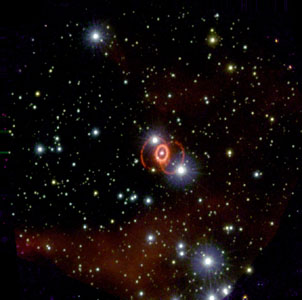
Supernova 1987A, spotted in February 1987 in the
southern hemisphere, La Silla Mountain, Chile
10.
Seen by the unaided eye, SN 1987A peaked with
magnitude of 3 in May of that year.